Essential Travel Safety Tips for First-Time Travelers

A first trip can feel exciting and unfamiliar at the same time, but a few useful habits make it easier to handle surprises. Travel safety tips help a first-time traveler prepare without turning each choice into a worry.
Travel may bring common risks, such as theft, scams, illness, or delays. You can reduce many problems with simple trip preparation and choices that fit your plans.
That preparation does not need to take over your vacation. A few key details sorted out ahead of time can make an unfamiliar place feel easier to manage.
When something changes, pause, look around, and choose your next step with care. Treat preparation as a way to enjoy the trip with more confidence, not as a reason to expect the worst.
Check Travel Advisories Before You Leave
Before booking or departing, check the State Department’s current advisory for every destination on your itinerary. Destination details help you judge what an advisory means for your plans.
International travel safety tips begin with checking both the advisory and its destination-specific details. The four advisory levels describe different degrees of caution, and their review intervals depend on the level.

Understand the four advisory levels
The State Department uses four travel advisory levels. Level 1 means “Exercise normal precautions,” while Level 2 means “Exercise increased caution.”
Level 3 means “Reconsider travel,” and Level 4 means “Do not travel.” Level 1 and Level 2 advisories are reviewed at least every 12 months.
| Level | Advisory wording | Minimum review interval |
|---|---|---|
| Level 1 | Exercise normal precautions | At least every 12 months |
| Level 2 | Exercise increased caution | At least every 12 months |
| Level 3 | Reconsider travel | At least every six months |
| Level 4 | Do not travel | At least every six months |
Level 3 and Level 4 advisories are reviewed at least every six months. The State Department can update any advisory between reviews when its posture changes, often due to ongoing security concerns.
A country can move to Level 4 between scheduled reviews, so a static list of countries with a Do Not Travel advisory can quickly become outdated.
Check each destination’s current Level 4 status instead of relying on a saved country list. Read the destination details for local risks and steps that may affect your route.
Register your itinerary and save consular details
The Smart Traveler Enrollment Program (STEP) is a free U.S. government service that lets U.S. citizens and nationals register international trips to receive alerts and emergency assistance.
Smart traveler enrollment can help the U.S. government reach you during an emergency. The traveler enrollment program also lets you receive destination updates while abroad.
Save the nearest U.S. consulate’s contact details somewhere you can reach without internet access. Recheck the advisory shortly before departure because the government’s posture can change.
If your passport disappears, having a separate copy and a trusted person with your itinerary can make the first steps less stressful. A little planning gives you and a family member a clear place to start.
Make two passport copies and keep them apart from the original. A U.S. embassy or consulate can help if your passport is lost or stolen abroad.
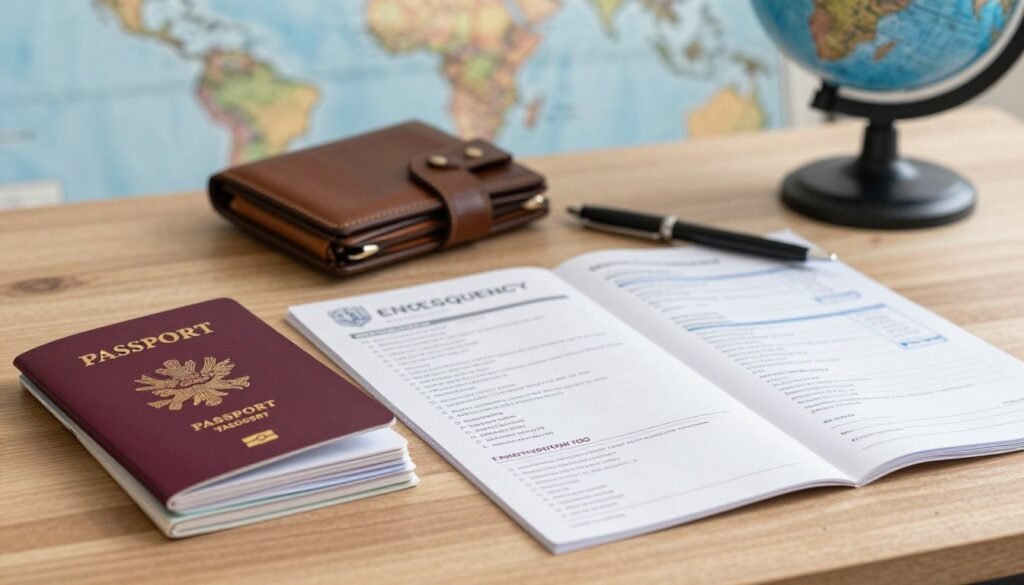
Use this short checklist before leaving home:
- Make two passport copies; store one apart from the original and leave one with a trusted person.
- Share your itinerary, addresses, phone numbers, and emergency contacts with that person.
- Save a digital copy of important documents in a secure account or device.
- Carry enough local currency for one small arrival expense, such as a taxi.
A separate copy can support the steps to replace a missing passport. Keep your trusted person’s contact details with your travel papers, not only on your phone.
Wait until you are home to post real-time vacation updates. Public posts can tell others that your home is empty while you are away.
Make sure the person holding your itinerary knows how to reach you if plans change. Keep the original passport in a secure place and carry only the copy when a copy will serve.
Protect Your Cash and Credit Cards
A lost wallet is less disruptive when your backup card and reserve cash are stored somewhere separate. Separate storage helps you pay for essentials if your daily wallet goes missing.
Carry only the credit cards and bank cards you expect to use. Before departure, tell your credit card company your destination and travel dates, then check your credit limit.
Carry only the payment methods you need
A card company may flag unfamiliar charges, so share your plans before you leave. Ask your bank for a chip-enabled card if you need one for your destination.
Keep a backup credit card or bank card in a different secure place from your daily wallet. That way, losing one set of credit cards does not leave you without another way to pay.
Divide cash and cards between separate secure places, such as a wallet and a locked bag. Keep a small amount of cash easy to reach for a quick purchase.
Keep backup money and account details separate
Choose a safe location for backup account details, such as a secure digital vault. Do not leave account numbers or access codes in a decoy wallet.
A decoy wallet should never contain real account details or replace a genuine backup payment method kept safe. It cannot help if your real credit card and reserve cash are all together.
Check that you can reach your bank or card company if a card is lost or declined. Keep its contact details in a secure place separate from the card itself.
Before leaving an ATM, take a moment to confirm that you have your card, cash, and receipt.
Stay Alert in Airports, Streets, and Transit
A crowded airport or station gives a distracted traveler less time to notice a bag being handled or a sudden diversion. Stay aware of your surroundings, especially when people move close to your belongings.
Keep bags and electronics in view at airports, and let only uniformed airline staff handle checked bags. Staged bumps or spills can distract you while an accomplice targets your things.
Carry a wallet in an inside front pocket, or hold a purse close to your body. Keep valuables, flashy jewelry, and expensive electronics out of sight when you can.
Use familiar routes and keep your head up instead of looking at your phone while walking. Domestic travel safety tips rely on the same situational awareness as international trips, even when the destination feels familiar.
Use these four safety tips in busy places:
- Scan for exits when you enter a crowded space.
- Keep bags in front of you and within view.
- Avoid displaying valuables in public.
- Move to a populated, staffed place if you feel uncomfortable.
If someone’s behavior feels threatening, step into a staffed business and ask for help. If a street or transit area feels unsafe, choose a busy, staffed place rather than an isolated shortcut.
Make Safer Choices on Roads, at Hotels, and at Night
For a road trip, knowing the route and the rental car’s controls before leaving the lot is safer than figuring them out in traffic. Plan the drive and choose a car suited to the trip.
Safety rules for traveling on the road start with a route plan and a car suited to the trip. Business travel safety tips include learning the route, checking the controls, locking doors, and hiding luggage.
Park in well-lit areas and check the back seat and floors before entering. NHTSA’s early estimate counted 36,640 U.S. motor vehicle traffic deaths in 2025, down about 6.7% from 39,254 in 2024.
The early estimated fatality rate was 1.10 deaths per 100 million vehicle miles traveled in 2025, compared with 1.19 in 2024. These national estimates are not a prediction of your personal risk.
For RV travel, the 3-3-3 rule recommends driving no more than 300 miles per day, staying three nights at each campground, and arriving by 3 p.m. Stop every three hours to stretch, drink water, and rest.
At a hotel, use the door locks and learn where the fire exits are. Verify unexpected visitors with the front desk, and ask staff about neighborhood safety and taxi routes and costs.
At night, avoid mixing alcohol with driving, water activities, or heights. Keep drinks in sight, avoid homemade or bootleg alcohol, and check local laws and medication rules before drinking or traveling with prescriptions.
Do not drive when tired or impaired, even when the next stop is close.
Travel Safety Tips for Kids and Families
Families traveling across a border should check consent requirements before departure, because a destination may ask for a letter when a child has only one accompanying parent or guardian. Rules differ by destination, so check the country’s entry requirements.
Travel safety tips for kids include preparing a consent letter when a child travels internationally alone or with only one parent or legal guardian. The letter is preferably in English and notarized.
Prepare consent documents for children
When one custodial parent travels with a child, the other parent should sign the letter. Both parents should sign when the child travels alone or with a guardian.
Ask what documents the destination requires before travel. Carry the signed letter with the child’s other travel papers so it is ready at the border.
Secure children in an approved airplane restraint
The FAA strongly urges parents to secure children in an approved child restraint system (CRS) or other approved device for the whole flight. A CRS or device in the child’s own seat is safer for a child under 2 than traveling on a lap.
Buying a ticket for a child under 2 is the only way to guarantee use of a CRS on a U.S. airplane. A CRS must be approved for aircraft use, and its label and maker’s instructions matter.
The FAA prohibits baby carriers, booster seats, and backless CRSs during ground movement, takeoff, and landing. The following options have different use rules.
| Option | Who can use it | Key condition |
|---|---|---|
| CRS in the child’s own seat | Children with their own seat | Must be approved for aircraft use |
| FAA-certified CARES restraint | Children 22-44 pounds, up to 40 inches tall | Child must sit upright alone and occupy own seat |
| Lap travel | Child under 2 | Does not guarantee use of a CRS |
CARES is FAA-certified for children who weigh 22-44 pounds, are up to 40 inches tall, can sit upright alone, and occupy their own seat. Check the restraint’s aircraft-use label and manufacturer instructions before relying on it for a flight.
Prepare for Health Needs and Medical Emergencies
Before an international trip, make sure measles vaccination is up to date and review what your health insurance and travel policy actually cover. Coverage details can shape the help available during a medical emergency.
The CDC recommends that all travelers be fully vaccinated against measles with the MMR vaccine before international travel. Medical air evacuation can cost from $25,000 to more than $250,000.
Suggested medical evacuation coverage is at least $100,000 for most trips and $250,000 for higher-risk travel. The cost depends on your location, medical condition, and distance to an appropriate medical facility.
| Trip type | Suggested minimum evacuation coverage | Examples or condition |
|---|---|---|
| Most trips | At least $100,000 | General travel |
| Remote destinations | At least $250,000 | Far from appropriate care |
| Cruises or hazardous activities | At least $250,000 | Higher-risk travel |
Medical evacuation coverage usually needs insurer pre-approval. Rarely, immediate life-saving action may happen before approval.
Most policies require you to notify the insurer within 24-48 hours of a health emergency.
Read your policy before travel to learn who must call and what details the insurer needs. Your health plan may not cover every medical cost abroad, so compare its limits with your travel policy.
Save the insurer’s emergency contact details where you can reach them without relying on your phone.
Conclusion
A safer trip starts with a few useful choices made before leaving home. Smart traveler habits pair preparation with attention to changing conditions.
Keep your plans flexible enough to respond when a delay, alert, or health need changes your day. You do not need to predict every problem to make a sound choice.
Start with one practical step: check the destination advisory and save key emergency contacts before departure. Those details can help you act faster if plans shift.
Take five minutes today to check your destination’s current advisory and save the contacts you would need in an emergency.